
Homestead Flood Cleanup
Precision Flood Remediation And Structural Drying
Our technicians have spent over a decade stabilizing residential structures across the Redland and surrounding agricultural flatlands after tropical downpours.
A widespread issue seen after major storms is that uninsured homeowners face urgent uncertainty regarding proper drywall flood cuts and structural drying protocols needed to prevent rot in flooded wall framing after major storms.
We eliminate that uncertainty by taking precise moisture readings and performing clean horizontal cuts twelve inches above the water mark to ventilate wall cavities.
Whether dealing with shallow slab intrusion or complete room submersion, property owners rely on our certified crews when they schedule our complete water damage restoration services.
Every project concludes with botanical sanitizing and thorough digital moisture mapping so you possess verifiable proof that your structural framing is dry.
How We Extract Water And Dry Your Property
Homeowners often describe how mopping standing floodwater and using household box fans without industrial drying equipment frequently causes concealed mold to proliferate behind baseboards and interior walls. Our engineered four-stage protocol halts secondary destruction by deploying industrial extraction and commercial airflow, seamlessly stabilizing your home with storm damage repair before microbial colonies form.
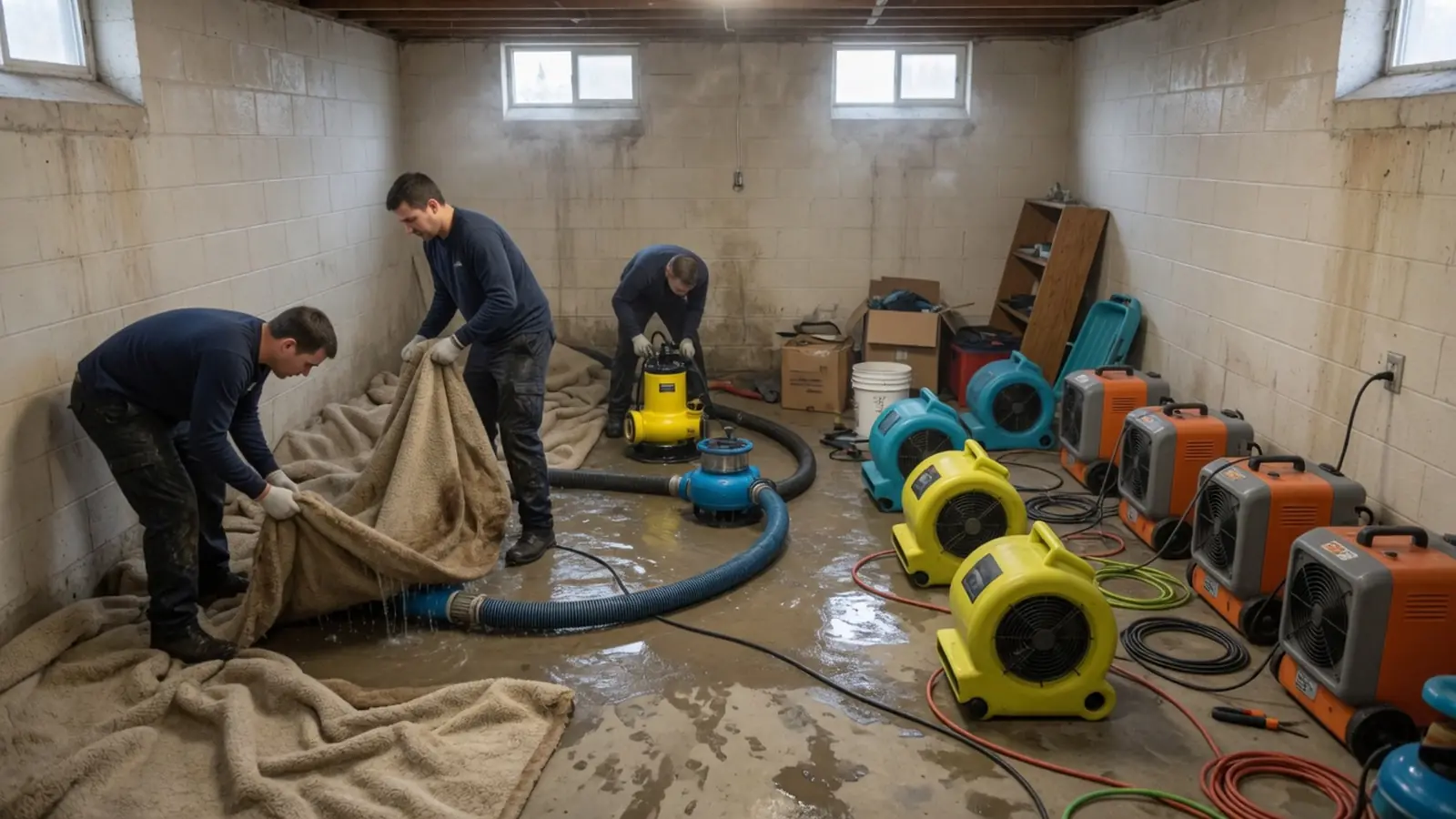
- Emergency Extraction And Inspection. Technicians deploy high-volume submersible pumps and weighted extraction tools to pull standing water out of tile grout lines, subfloors, and concrete slabs.
- Controlled Demolition And Flood Cuts. We remove non-salvageable wet insulation, peel back swollen baseboards, and execute neat flood cuts above the moisture line to expose trapped moisture within interior wall cavities.
- Antimicrobial Treatment And Disinfection. Because homeowners struggle with selecting the right antimicrobial sprays and fungicides to treat stripped wall framing before mold sets in following indoor floodwaters, our licensed technicians apply EPA-registered botanical biocides directly to exposed wood framing to eliminate fungal roots.
- Structural Dehumidification And Air Scrubbing. To ensure residents do not experience persistent musty odors and airborne mold spores circulating through the air conditioning system even after initial flood mitigation drying is complete, we run high-capacity commercial dehumidifiers and negative-air HEPA scrubbers until structural equilibrium is achieved.
Transparent Billing And Scientific Drying
We recognize that homeowners encounter unexpected high costs and billing confusion regarding daily rental rates for commercial dehumidifiers and air scrubbers deployed during water mitigation. Our team eliminates pricing uncertainty with itemized daily equipment logs and standardized regional pricing that insurance carriers accept without friction. We adhere strictly to IICRC S500 standards for professional water damage restoration, pairing daily moisture documentation with certified mold remediation to stop fungal spread so your property is guaranteed dry.
AC Leak And Utility Closet Mitigation
Overflowing air conditioner condensate lines lead to saturated drywall and visible mold colonies developing inside enclosed utility closets in humid regions. We extract stagnant condensate water, remove soggy drywall, and thoroughly sanitize tight utility spaces to safeguard your indoor air quality.
Basement And Slab Water Removal
Subtropical downpours and low-lying water tables frequently push floodwaters across foundation slabs. We deploy industrial extraction units to remove pooled water, pull moisture out of concrete foundations, and prevent long-term structural decay.
Sanitizing And Structural Deodorization
Floodwaters carry contaminants that soak into framing and subfloors. We apply hospital-grade botanical antimicrobials and run hydroxyl generators to neutralize foul odors and eradicate micro-pollutants throughout the structure.
Our Scientific Approach To Flood Recovery
Every water emergency demands rigorous technical discipline rather than rushed guesswork. We measure ambient relative humidity, specific humidity ratios, and deep material moisture content to ensure structural framing is thoroughly dried before repairs begin.
- 12Zip Codes Served
- 6Service Areas
- 3Services Offered
Homeowners who experienced sudden flooding share how our rapid response, meticulous drying protocols, and transparent communication helped them recover safely.
“When rising water breached our family room, the crew handled the local moisture inspection paperwork and structural sign-off on their very first visit. They knew precisely how high to open the sheetrock to satisfy municipal building inspectors, which kept our reconstruction timeline on schedule. Their thorough documentation saved us from dealing with code violations.”
Marcus T.
“Every morning began with photo updates and moisture level readings sent directly to my phone, so I never had to hunt anyone down for status reports. The team explained what each dehumidifier reading meant and confirmed when drying targets were achieved. Having that steady stream of clear communication gave our family total peace of mind.”
Elena V.
“Rather than pushing for expensive total tear-outs of our framing, the crew explained how applying a specialized botanical wash would disinfect the studs without degrading the wood fibers. They showed us where subflooring could be preserved safely and where replacement was strictly necessary, saving us thousands on rebuilding costs. Their honest guidance helped us invest in materials that resist future humidity.”
Derrick K.
“A severe thunderstorm knocked out neighborhood electrical power right as extraction began, which could have stalled everything for days. The team immediately dispatched mobile generators to power the industrial air scrubbers and kept the drying process moving without losing a single hour. Their quick pivot under difficult field conditions prevented mold from taking hold.”
Patricia N.
Frequently Asked Questions
Can carpet, padding, and baseboards be sanitized and saved after floodwater enters a home, or must they always be removed and replaced?
Contaminated floodwater requires removing porous carpet padding and baseboards, while salvageable carpets require hot water extraction. Category three floodwaters carry biohazards that saturate porous subfloors and foam pads beyond sanitation. While select synthetic carpets exposed to clean water can be disinfected, organic baseboards and wet foam padding must be replaced to prevent colonization.
How are commercial dehumidifiers and air scrubbers billed during water mitigation?
Mitigation equipment is billed on standard daily rates established by regional insurance pricing guides without hidden charges. Daily rental units operate between three and five days on average to reach target wood moisture content. Each piece of hardware is logged by run hours to ensure fair, transparent billing that matches carrier adjusters' expectations.
How high should drywall flood cuts be made after indoor flooding occurs?
Drywall flood cuts should be made twelve to twenty-four inches above the peak water line to ensure framing dries completely. Cutting well above the moisture migration mark exposes wall cavities, allowing high-velocity air movers to circulate around wall studs. This critical measure prevents wet insulation from holding hidden moisture against wooden plates.
Why do musty odors linger after floodwaters are extracted from living spaces?
Residual dampness inside closed air ducts and structural framing permits airborne mold spores to circulate continuously. Running regular HVAC blowers pulls lingering moisture into fiberglass duct insulation where microbial colonies multiply. True odor elimination requires duct disinfection, HEPA air filtration, and lowering indoor relative humidity below fifty percent.
How do technicians verify that flooded wall cavities are dry enough for rebuilding?
Calibrated pinless and penetrating moisture meters confirm wood framing has returned to its dry standard of sixteen percent. Surface touch tests fail to detect deep core saturation in bottom plates and concrete slabs. Detailed moisture logs certify structural dryness before new drywall is hung, preventing structural rot and securing compliance with regional building standards.